Showing posts with label markets. Show all posts

July 18, 2011

Shop like a local at Marche D'Aligre

There are literally a dozen of food markets in every arrondissement in Paris that it is hard to miss them. These temporary markets operate mostly twice a week in the morning and offer fresh produce from the farms, or more likely from one of the wholesalers. Depending on where you live, you might even have two or three such markets serving your neighbourhood.


Spending a morning at a market can be great way to practise my French as well as to stock up a weekly supply of fresh fruits and vegetables. Not to mention that the Paris market experience is always a colourful and stimulating one. I find the most popular and centrally located ones tend to be frequented by tourists, hence their high prices. So I am keen to explore other areas that might give me better value for money.

Cherries sell for 3 euros per kilo
Marche D'Aligre, in the 12th arrondissement, is no doubt a place for the locals. It is by far one of the most affordable markets in Paris. Oranges, the size of a grapefruit, can be had for 50 cents each and girolle mushrooms are priced at 4.95 euro for 500 grams. Fruit and vegetable stalls dominate the open-air market in Place d'Aligre, while the meat, poultry, fish, cheese and charcuterie are sold indoor at the adjacent Marche Beauvau.  At the other end of the square, there is a small flea market that sells bric-a-brac and the sort of antiques that could only have come from a car-boot sale. I was actually surprised to see there was a demand for old photographs at one euro a piece.

The covered market at Marche d'Aligre

Products nicely displayed inside the market


Skate wings are wonderful if you know how to cook them

Whilst in this vicinity, Sabah would make a nice stop to pick up some oriental products. Located near rue d'Aligre, this famous grocer carries all the spices and herbs necessary for cooking Asian, African, Indian, North African and Middle-Eastern dishes - effectively catering to all the ethnic minorities in Paris. Their large selection of herbs, nuts and dried fruits or even rice and oils are considerably less expensive than what they would be sold at supermarkets. No wonder the place is always packed.

Sabah specialises in oriental spices and herbs

June 30, 2011

Rungis, the world's biggest food market

Entrance to one of the many food halls at Rungis
Rungis is not a food market where you can just go and pick up some cheeses, meat and salad leaves. In fact, you cannot even get in unless you are taken on a tour of the complex that covers an enormous area of over 200 hectares. Just a 20 mins drive from Paris, Rungis is the world's biggest wholesale market for fresh produce and that is where Parisian chefs buy what they cook. Traders from all over Europe also come to buy and sell their produce in Rungis.  This place is much more than a wholesale market for Parisian restaurateurs.

I was lucky enough to visit the market on a school trip organised by Le Cordon Bleu and upon arrival, we had to put on a set of disposable outfit before entering the food halls. Our tour began with the Pavillon de la vollaile and for the next three hours, we were in and out of different compounds in a freezing cold temperature, posing in front of animal carcasses, oversized cheese meules and rare, exotic plants.

Some poultry comes pre-packaged, like duck breast and foie gras, or as individual birds in cartons. Meat, apparently, is sold only by the carcass. 


There was practically nothing in the Fruits and Vegetables Hall that I had not seen elsewhere, but to encounter such quantities under one roof was nevertheless an eye-opening experience. Most stalls are highly specialised in their product offerings; there are ones who sell mushrooms exclusively while others carry only garlic heads and onions.

The Fruits and Vegetables Hall at Rungis is the largest of its kind in the world
Girolle is one of the most popular French champignons 
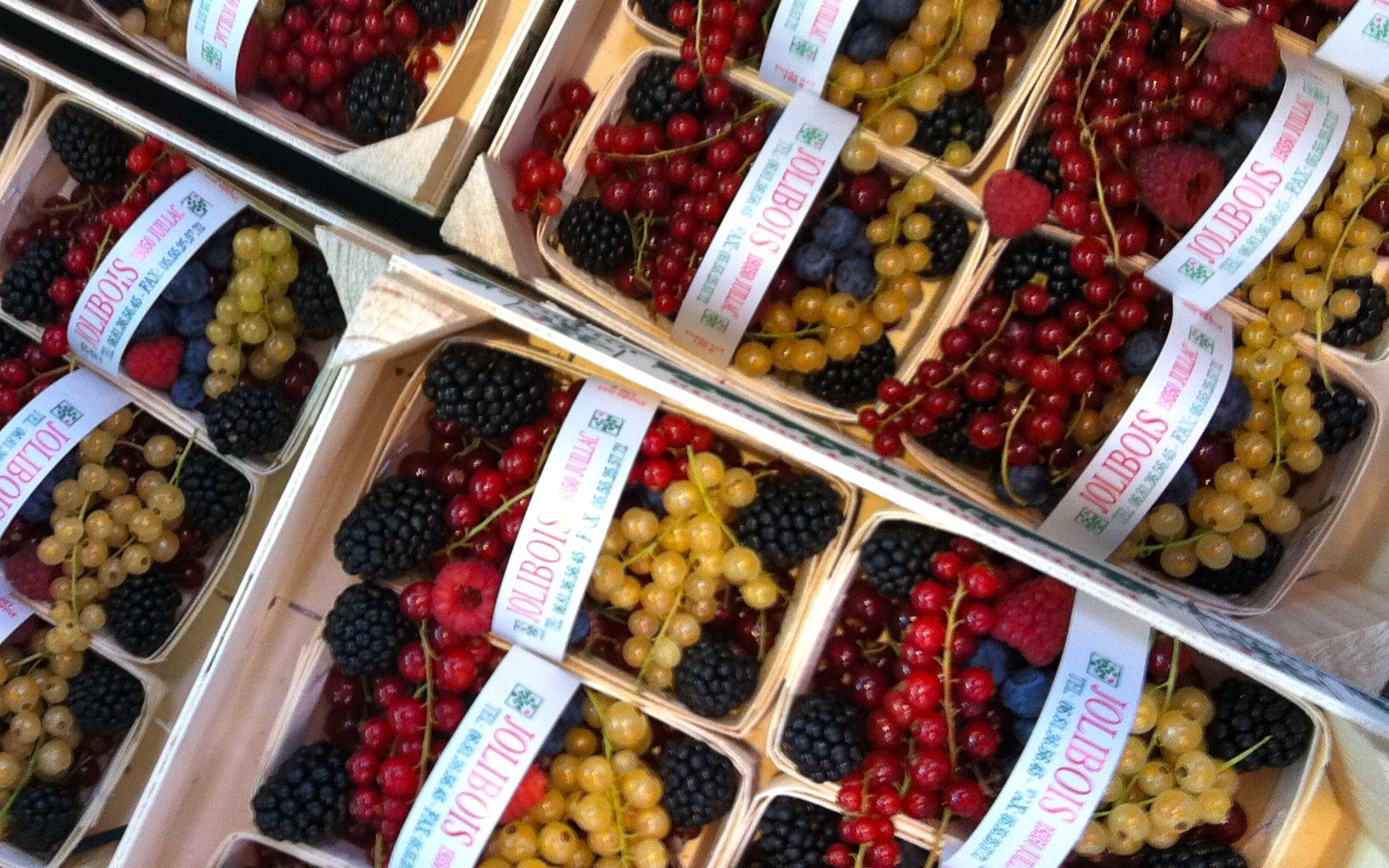
Summer is the season for berries
My favourite place in Rungis was the Cheese Hall. As I walked through its entrance, the aroma of cheese was immediately noticeable. There were commercially produced cheeses as well as a whole range of artisanal ones from smaller producers. The most impressive cheeses were the big meules of Emmental, Comte, Beaufort and Gruyere, some of which weighed as much as 120 kg each.

A large Emmental AOC cheese meule typically weighs from 70 to120 kg
These Comte cheeses weigh about 35 kg each

June 27, 2011

Nice - a jewel on the Mediterranean coast

Being the second most visited city after Paris, Nice attracts 4 million tourists yearly. The mild Mediterranean climate and stunning landscape first came to the attention of the English upper classes in the 18th century and they are still what attracts most visitors today.

Place Massena is the main square in Nice
Nice was Italian until 1860, and the pastel facades and balconies of the Old Town have a distinctly Italianate feel. The daily market in the cour Saleya is a bustling area which transforms into restaurants and pubs in the evening. But if you are more interested in food than people watching, you would avoid eating there for obvious reasons.

Yes, they are real tomatoes

Courgette flower makes great tempura

My favourite girolles are now coming from Spain
Of the very few Michelin starred restaurants in central Nice, I was thrilled to secure a table at Flaveur which is a smart little place with no more than 20 seats. Passion, freshness and personality summarise this eatery that overlooks a lovely garden square.

Salted cod with tomato ragout
A nice selection of entrees and plats du jour including salted cod, grilled veal, poached fish and steak tartare are on offer. The play on textures and exotic notes of flavours from the garnishes are well thought out and beautifully done.


Tartare de boeuf Charolais with panisse
Fish nicoise with cream of artichoke
One of their dessert specialties - croustillant rose-litchi mousse - certainly has got the wow factor. The crispy cylinder in the centre is filled with a lychee ice-cream. The pink rosettes are rose petal mousse with the lychee fruit. A dropper containing a rose petal perfume completes the dish with finesse and style.  Flaveur, in my opinion, is a deserving member of the Michelin starred accolade.


A short walk from the restaurant will lead you to the Cathedrale Orthodoxe Russe St-Nicolas which sticks out like a sore thumb in central Nice alongside its marble-cladded baroque counterpart. Built in 1912, the Russian Orthodox Cathedral is testimony to the presence of Russian nobility in Nice since the mid-19th century.  It is an interesting fact that the church was a gift from Tsar Nicholas II who visited Nice in 1864. It remains the largest Russian orthodox church outside Russia. The exterior is of pink brick and grey marble with elaborate mosiacs.

January 2, 2011

La Grande Epicerie - a mecca in gourmet food


Even those who are mildly interested in food would find a visit to La Grande Epicerie at Le Bon Marche a feast for the eye, if not for the stomach.

A stellar selection of all things edible is available for anyone with a deep pocket.  It was New Year's Eve and the place was completely packed with shoppers who were all too happy to pay heftily for the pleasure of a gourmet meal to celebrate the festivities.

Le Bon Marche itself is an interesting piece of history for the retail industry as it is regarded as the first department store in the world dating back to the first half of the 19th century.