March 29, 2011

France's favourite store

Today I found myself exploring for the first time the allure of frozen food.  For a country which has a long tradition of picking the freshest produce straight from the growers during market days, it comes as a surprise that the concept of frozen food would go down well with ordinary French folks.

The fact is the Picard logo is ubiquitous in France and not only is the chain well liked for its innovation, quality and value for money, it has captured the hearts and minds of the French public.  In a recent consumer survey, the brand topped Ikea and Amazon to be France's most popular store. There are 108 branches in Paris alone, and over 780 throughout the country.

At Picard, the kind of frozen food that we are familiar with has evolved into an impressive range of entrees, appetizers, main courses and mouth-watering desserts.

 A tempting range of bite-size petit fours and macarons 

Sorbets and ice creams in stunning presentation

True to the form of French haute cuisine, these could have come from Fauchon

Apparently everything in the store is flash-frozen which means they defrost very quickly and retain most of their nutrients. You can get every kind of fish imaginable and an interesting mix of the staple foods including beef, lamb, poultry, vegetables and fruit, both raw and prepared. The novelty of April, for instance, is the smoked salmon millefeuilles on the right which have been delicately assembled with fromage frais, basil, and vegetables.

Bags of frozen stock in cubes
Coming from a country where wet market is THE place to get fresh ingredients, I have to admit I am more drawn to the concept behind Picard as a brand than the products themselves. It is selling a new kind of lifestyle that appeals to the younger generation. If you want your potato in brunoise, why bother with the fuss by doing it yourself when they come out from a bag perfectly diced?  For me, the tiny boxes of frozen herbs and bags of veal stock and red wine sauce should prove to be  rather handy for the odd meal that I might be preparing one of these days.

A taste of Vietnamese pho

Hailed as the best Vietnamese pho in Paris, I enthusiastically made my way to Pho 14 along Avenue de Choisy to savour the wonderful beef stock that reminds me of a little restaurant called Locomotive back home in Causeway Bay.

This place is no different from many family-run businesses set up by immigrants of Chinese or Pan-Asian descent all over the world. Cheap and cheerful, there was no ambiance or comfort to speak of. But the pho noodle was rather tasty and came with a selection of cooked and raw beef, beef balls, plus the standard bean sprout, raw onion, mint leaves and chilli.  No one can complain about that for 8 euros which is a much welcome price-tag particularly in Paris.

Making it all the way to the 13th arrondissement meant that I was not prepared to go home empty-handed.  I strolled down the main street of 'Chinatown' to explore the Asian restaurants and supermarkets populating this district.  I have to say the restaurants looked like they have been there since the 1970s - dated, tired and mediocre. Walking pass some charred duck in the window did not instil a sense of confidence in the quality of Asian food served in this area.


At the other end of Avenue de Choisy I was pleasantly surprised to find Asian supermarkets, other than Tang Freres, that are well-stocked in fresh produce and Asian provisions. They carry all kinds of mangoes and fruits flown in from China and Thailand. Interestingly, most frozen foodstuff like spring rolls and dumplings are made locally and sold in bulk. For the uninitiated, these are the kinds of Chinese takeaway which the French people will sadly associate with our food culture.  I am hesitant to draw any conclusion on whether this misconception is widespread.  Having said that, however, the general sentiment towards the Asian immigrant population is positive.

The case for the North Africans is quite different unfortunately. The social burden placed upon the French government caused by an influx of immigrants is taking its toll.  More than half of the students in my language class at Alliance Francaise are from the African continent and their tuition fees are mostly paid by their employers.   Imagine those sitting at home, unemployed and surviving on social welfare. "Racism" is such a dirty word that any politically-correct person would try to avoid but there is no denying that the prevailing notion of the 'other' in France is very much alive.

March 21, 2011

Dazzling chocolate in Pantone colours


How about a 16-3768 red for a piece of chocolate?  Say no more, the inspiration must have been drawn from Pantone - the colour matching system. They look more like eye makeup than they do bonbons! These appealing colour swatch nibbles are so precisely executed AND so minimalist that it could only have come from a Japanese artist! Well, Sudaharu Aoki is not exactly an artist, he is a patissier. But then every patissier of note considers his creations a work of art and Aoki is no exception.


Behind the uniformity in shape and size, the flavours are diverse as they are inventive. I can't help but wonder what 'bamboo' or 'wasabi' chocolate would taste like?  They are not only fun and different, but they also express a modern attitude towards chocolate which is a statement in itself.  Aoki's boutiques are now in Paris and Tokyo and I won't be surprised to see him into New York or Shanghai.

March 20, 2011

The cook's paradise

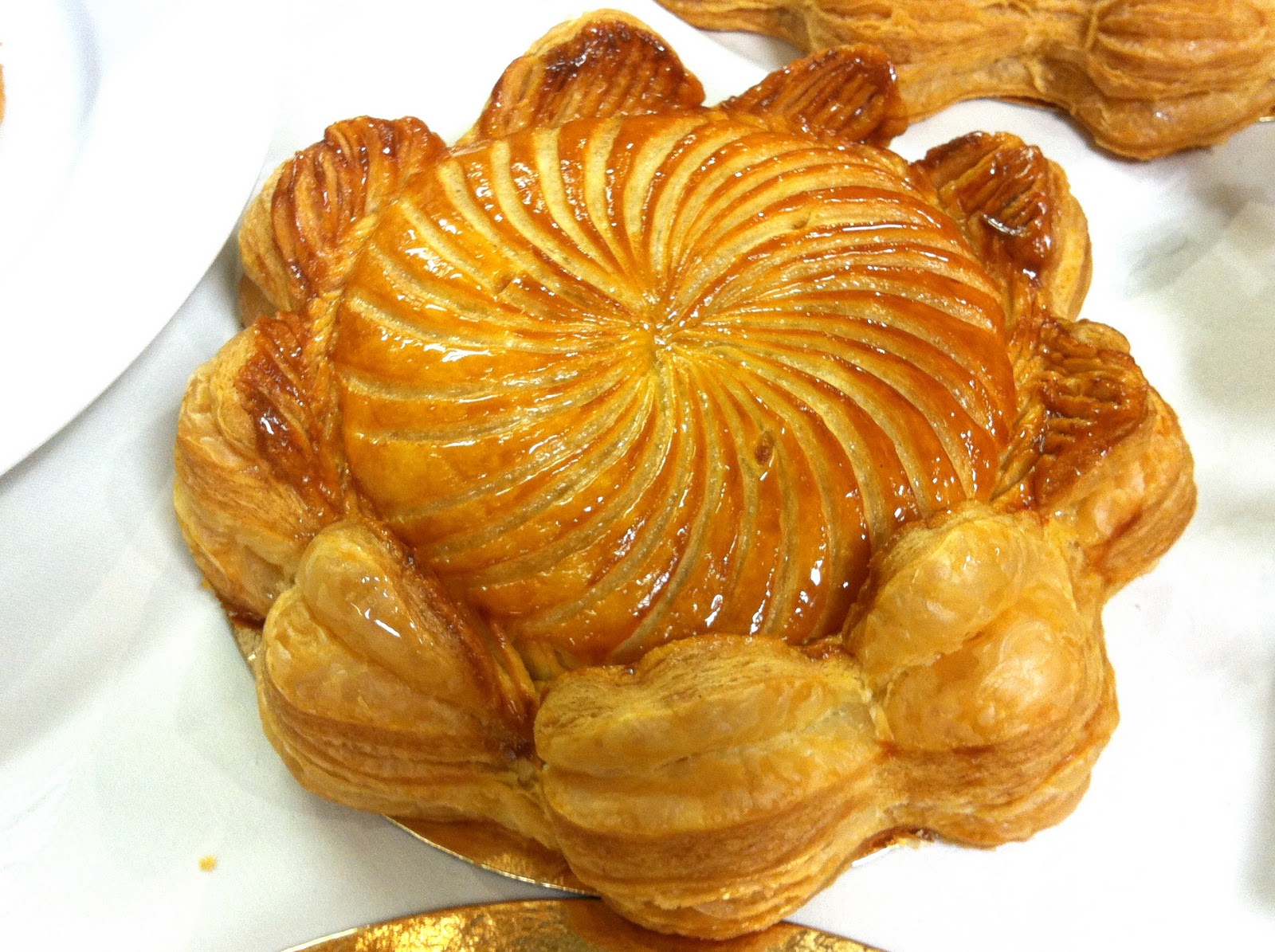
My other life training to be an aspiring pastry chef has proven to be more challenging than I would care to admit.  Before the final exam, I tested out six recipes over the weekend only to find that I was going to make Pithivier, an almond cream puff pastry which was about the least technical recipe out of the 50 odd gateaux and tartelettes that we learned.

Pithivier was traditionally eaten on the tenth day after the birth of Jesus

All the effort that went into the scouting for the right kitchen utensils and ingredients for the trial run was quite a task in itself. In Paris, most professional kitchenware shops are centred around Les Halles on rue Montmartre. Shops like Mora, A Simon and E Dehillerin have been around for a long time and they stock every conceivable shape and size of moulds and piping nozzles, plus any number of useful tools that you never knew existed - all still made in France to my disbelief! I am already working out my container's list heading the other direction.

The day that I had enough of pastry making, I went lunching at a neighbourhood bistro serving Basque dishes. Afaria has a small but interesting menu. I ordered from the 'Return Trip' section that suggests the dishes are inspired by the Basque tradition (southern France). The starter, pumpkin soup served with scallop tartare, was a refreshing combination of hot and cold. The grilled fish in a hazelnut crust with braised leeks was flavourful and the cooking point was perfect.

Pumpkin soup with scallop tartare
Grilled fish in a hazelhut crust
Judging from the standard of the food served in the 15th arrondissement, I am rather happy with the fact that decent meals can still be found in this area without the price tag of a more trendy district.

March 7, 2011

Blending the Middle Age with the Contemporary

On Sunday mornings, to visit a church is like going to a wedding without an invitation.  After having a nice expresso on Rue Mouffetard, I decided to explore a 'religious' site of a different kind - a place of intellectual exchange.  

The College des Bernardins in the 5th arrondissement is an outstanding example of Cistercian architecture, a style most associated with churches and monasteries of the Roman Catholic Cistercian order.  It stressed simplicity and avoided any superfluous ornamentations that were seen to distract from piety.  The austere aesthetics of the Cistercians was expressed in pointed arches and ribbed vaults made entirely out of stone.

The College was constructed in 1248 when universities were popping up all over Europe - Paris, Oxford, Cambridge, Heidelberg, Bologna.  After the French Revolution, it was took over by the Government and had served as a prison, a warehouse and even a fire station. The College was completely renovated and reopened in 2008 as a catholic artistic and cultural centre.


Showing now at the College des Bernardins is a light installation Between You and I by American avant-garde artist Anthony McCall.  His simple projections that emphasised the sculptural qualities of a beam of light was theatrical and lyrical. As the viewer moved around the work in the pitch-black space, the observer would in turn become the observed as he came under the light. 


March 4, 2011

Modern French cuisine at Le Dauphin

Recently named the 11th best restaurant in the world, Le Chateaubriand in the 11th arrondisement and its chef Inaki Aizpitarte are making the headlines in the culinary world.  Anyone who couldn't wait for weeks to get a table in Le Chateaubriand should try out its sibling Le Dauphin, a wine bar located just next door.

I liked the cool, contemporary feel of Le Dauphin as soon as I stepped inside. The lunch menu of the day promised an interesting combination of ingredients and flavours. Aizpitarte's approach to food was so refreshing compared with all the bistro fare that I have tried in Paris. I am sure some people might even find it a bit odd, but I simply loved it. The starters, in particular, were a daring play of various cooking points that would only work with the freshest ingredients. The end result was a delight.  Now all the more I am convinced I have to put my name down for Le Chateaubriand.

Starters
Raw oyster, mozarella cheese and red cabbage
Bouillon of clams, prawns and celery

Main Course
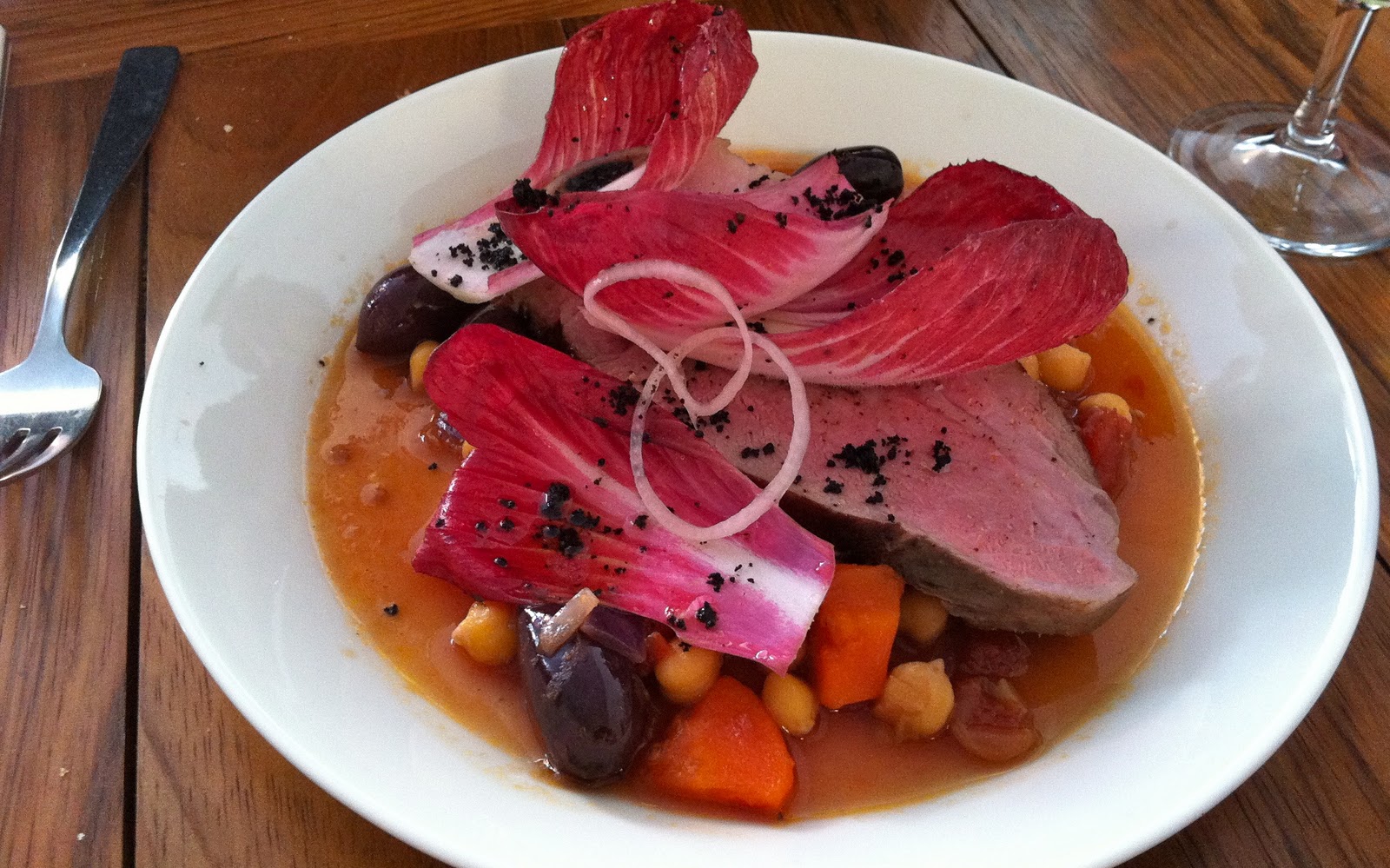
Veal with chickpeas and radicchio
Pollack with chickpeas and radicchio
 Cheese and Dessert
Tiramisu with passionfruit 
Brie de Meau

February 25, 2011

Chongqing cuisine right in the heart of Paris!

Gi Gong Bao from Chongqing
There is no authentic Chinese food in Paris - only a curious amalgam of Chinese, Thai and Vietnamese cuisine, so I was told.   Either the experts have been looking in the wrong places, or I got really lucky, I had the pleasure of tasting the famous Chongqing 'chicken hotpot' in an obscure little eatery in the 9th arrondissement. I have to admit that I have never had it before in Hong Kong but my Shanghainese friend vouched for its authenticity. The poussin was tender, flavourful and not overly spicy. Stock was then added to the pot in which vegetables, tofu, vermicelli and sliced beef were cooked at your own pace.

Chinese fondue - the longer the soup is simmered, the spicier it gets.
Regional cuisine from Chongqing has become so popular in Shanghai in recent years that there is an entire street serving dishes of this sort. We had a lovely chat with the Shanghainese chef and his wife from Guangdong who warmly introduced us to this wonderful dish.  I feel blessed that in a round about way, I am exposed a different kind of Chinese cuisine that Hong Kong as a city of culinary delights has yet to embrace.

February 12, 2011

Prix fixe menu in the 5th

The bistro Les Papilles is the kind of place that you need not worry about what to order - it is a prix fixe with no option menu.  This informal little eatery is situated slightly off the beaten track near the Luxembourg garden. Wine can be picked off the shelf at cellar price plus 7 euros for corkage but there is no option to order wine by the glass which I find a bit restricting for solo diners.


The food was well prepared, rustic, flavourful and came in generous portions.  For a four-course meal that includes a soup, a main course, cheese and dessert, the price of 33 euros is reasonable especially for dinner.  In my opinion, the overall quality had not suffered from the choice of less expensive ingredients.

Celeriac and celery soup with lardon and croutons

Braised beef cheek in red wine sauce and vegetables 
Panna cotta with pineapple sabayon
The fact that there was a room full of English-speaking diners says something about this place.  The no option menu that provides little variation other than to keep the product and labour costs down is also indicative of the kind of practice that is geared towards a tourist clientele.

Regardless, Les Papilles is still a place worth visiting for a wholesome and delicious meal in the 5th arrondissement.

January 31, 2011

Paris at the dawn of the 20th century

In 1900, Paris entered a new era of mobility with the inauguration of the Paris Metro that has become the symbol of the city.

Hector Guimard crowned the iconic metro entrances with his organic, curvilinear forms that epitomised Art Nouveau - an art movement that peaked in popularity throughout Europe at the turn of the last century. There are many fine examples of architecture in this style, notably by Victor Horta in Brussel and Antonio Gaudi in Barcelona.

Cast-iron balustrade decorated in botanic motifs
The last vestiges of Art Nouveau in Paris are probably best preserved in Musee Carnavalet.  Czech artist Alphonse Mucha's design for the Fouquet jewellery shop in Paris in 1900 was reassembled here after its removal from the original site. Also of interest is an interior designed by Guimard.

Mucha's Art Nouveau design was also popularised by Liberty & Co in London
In Germany, the decorative style of Art Nouveau is termed Jugenstil
Guimard's sinuous forms in a domestic setting
One of the most interesting aspects of Art Nouveau is the philosophy behind it.  Art should be a way of life.  The movement was a reaction against all things classical and aimed to break down the barriers between fine arts and applied arts.  The fact that everyday objects could be a work of art in the 1900s underlines a new way of thinking in modern society and the changing attitude towards the nature of art.   

It seems least surprising that in 1917 avant-garde artist, Marcel Duchamp, created his most prominent work, Fountain, out of a urinal.  It was Dadaism but it also raised important questions about the concept of art that even artists of today are still trying to address.

January 30, 2011

Guess where the famous LV graphics had come from?


For those who own an LV bag, I would imagine the likelihood of them knowing the origin of the famous quatrefoil and flower pattern is pretty slim.  In the latter half of the 1850s, the soaring success of Louis Vuitton's innovative flat-top trunks using waterproof and lightweight canvas had led to widespread imitations.  To combat the copycats, a uniquely different design had to be adopted.  Before that, their luxury trunks looked more functional than stylish.


By the end of the 19th century, Vuitton launched and patented the signature LV monogram canvas that featured the graphic symbols of quatrefoil and flower that were inspired by Japanese and Oriental designs.  The rest is history. In a 2010 study, Louis Vuitton and the LV monogram is the world's 29th most valuable brands.

Over the years, Louis Vuitton and his family have worked with numerous royalties and celebrities of their time.  The majority of their commissions were one-off designs tailored to specific needs of their clients, like the foldable day bed and the bureau.

A travelling folding bed that fits in a trunk
An office on the move
The romantic notion of travelling on a hot-air balloon, like the ill-fated Lindbergh, across the Atlantic Ocean gives you an idea of how aristocratic the whole business of travelling could be in those days.  No expense was spared to make sure the experience would make perfectly good dinner conversations over a glass of champagne.
The stained glass that decorated the original shop on rue Scribe, Paris. Circa 1900s.


January 29, 2011

Little joint along the River Seine

My craving for a decent 'savoury-only' lunch has been escalating to the point that it is now unstoppable. Luckily the weekend is full of possibilities as most restaurants are open and I got lucky by ringing Le Reminet at 11:30 to make a reservation for lunch on the same day.

I was initially a bit skeptical about this bistro due to its close proximity to the Notre Dame Cathedral, but on my friend's recommendation, I was willing to give it a try. The decor was classy and the food were well-executed with a contemporary twist in its presentation.

The 3-course lunch menu written on a chalkboard is quite a steal for 18 euros.

Smoked salmon with endives and apples
Ham steak with mashed potato
Cheese Platter
Apart from the main course which was the ham steak that I thought was over seasoned, both the starter and the cheese course were delicious and presented with a flair.

Then, what came immediately after lunch could easily be the highlight of my day out. I wandered off to Berthillon, my favourite ice-cream shop and had a scoop of raspberry sorbet infused with rose petals.  And it was the best sorbet I have ever had in my life!  This was bliss.

Who moved my macaron?

In a country that is obsessed with macarons, I am still amazed to see how Parisiens and tourists alike are queuing up in front of Laduree and Pierre Herme for their share of those precious, jewel-like almond meringues.

Pierre Herme store on rue Bonaparte on a rainy evening
No doubt they are very appealing visually, but some people think they are too sweet, me included.  I have tried making them myself by using less sugar but tweaking the proportion of sugar content in this recipe can be tricky.


The Paris macaron, as we know it today, is the creation of Laduree. Filled with a layer of ganache, buttercream, or jam and sandwiched between two almond meringue cookies, macarons have travelled far and wide in their popularity.  In Paris, perhaps the only serious competition for Laduree is Pierre Herme, whose outlets can be found in all the posh department stores. Trained at Lenotre and worked in Fauchon before he started out on his own, his constant innovations in blending new flavours and colours to stunning effects are absolute crowd pleasers!

So which one is better, Laduree or Pierre Herme? There is no question that both macarons are exceptionally airy, moist and melt instantly in your mouth. It really comes down to a matter of flavour.  For purists, probably Laduree will be your choice.  For the more adventurous, Pierre Herme's range is more exotic and varied! Try both and decide for yourself which one you prefer. My verdict is still undecided at this point...

January 27, 2011

Bouchon Abel, depuis 1928

Bouchons in Lyon pride themselves in serving traditional fares from their mother's table.  There is nothing fancy in terms of presentation.  Just rustic, down-to-earth recipes that have been passed down from generations of home cooking.

Bouchons are ubiquitous in Lyon especially in the Old Town and it is easy to end up in a tourist trap. Cafe Comptoir Abel was mentioned in Lebovitz's review, so I thought I would give it a try.

As though it was frozen in time, Abel is one of the those places that exudes nostalgia and charm. The menu chalkboard shows some interesting dishes, if not entirely catered to the English or American tastes.  Tripes and blood sausage, for example, are standard choices. 

The set lunch menu offers a sample of local cuisine like their Lyonnaise salads and creamed chicken - hearty and delicious. 

Salade Lyonnaise
Chicken with Supreme sauce and rice
Chocolate cake with vanilla sauce